So, wow. That was an experience. It was pretty brutal but I did make it all the way to the top (and, more to the point, back down again). Total climbing time was 8 hours to get to the peak, and 6 to get back down.
I didn't take a picture of this before leaving, since I ended up packing in a hurry, but here's what I took:
* food: onigiri w/mysterious filling (turned out to be some sort of meat), squid jerky, chocolate covered almonds, dried pineapple chunks, an apple, almonds, wasabi peas
* 2 litre bottle of water
* sunblock
* dollar store rain poncho
* dollar store LED flashlight
* camera
* winter clothes: wool hat, scarf, fleece, long-sleeved thermal shirt, leg warmers, extra socks, gloves
I thought, when we started out, that I was bringing too much food and possibly too much warm clothing. Turns out I needed (and was grateful for!) all of both.
Class ends early on Fridays, so at noon I had a few hours to pay for the trip, eat lunch and run to the store for a few last-minute essentials (primarily batteries for the dollar-store flashlight). When I got to the school, Yolanda-san was walking up to Aoi Hall, so we went in together and chatted while we waited for everything to get organized. She told me about
altitude sickness, which I found fairly creepy, especially since it can apparently happen to anyone, even people who climb mountains fairly regularly.
On the bus, we met Colin-san, the Yamasa employee who would be serving as our tour guide for the trip. Welcoming us all to the trip, he said something like "Climbing Mt. Fuji is not fun. It's a death march through a barren lunar landscape of rocks and ash." Which we kind of laughed off (fools that we were). Then he told Yolanda-san and myself about last year's Yamasa trip, where they didn't make it to the peak because it was bucketing rain for the entire time. It sounded like a completely miserable experience. I kind of wondered to myself whether I was going to enjoy it, but shrugged and decided it was too late to back out. ^_^;;
During the drive up, Colin-san regaled me and Yolanda-san with this fascinating summary of local history that sounded like it could've been a movie plot -- full of samurai intrigue and heroics. Super interesting stuff.
I tried to nap a little on the bus but wasn't feeling tired enough. So I just listened to some music, ate carbs (yay onigiri) and tried not to worry about what I'd gotten myself into.
There's this thing where you can buy a walking stick at the bottom of the mountain and get it stamped with a different insignia at all the mountain huts along the way, and at the peak. After waffling a bit about whether I wanted one, I bought my own stick at the final rest stop before Shin-5-gome. Some of the people in our group asserted that it wouldn't be that useful, or would only be useful for the downward part of the climb, and I wondered whether I really wanted to carry it all the way up the mountain and back. Finally I decided I may as well spend the ¥1050 and get the full experience. This turned out to be possibly my best decision of the trip.
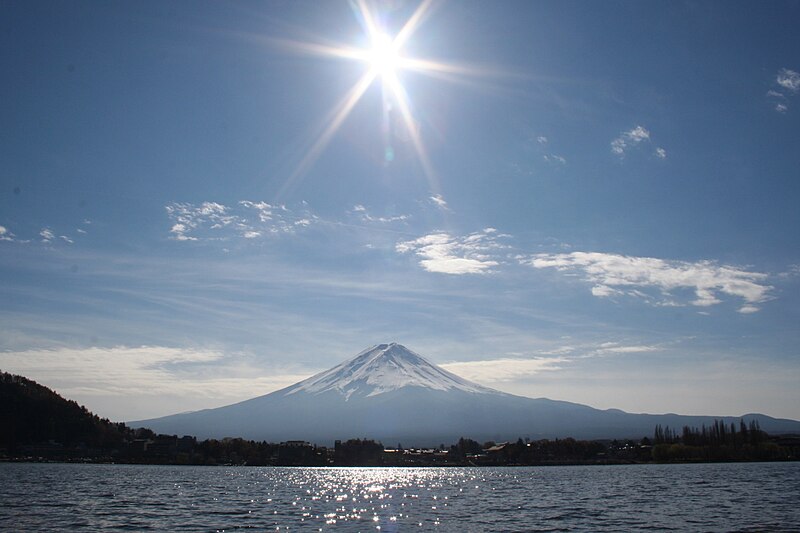
I have no pictures of Fuji-san from far away or from the outset of our hike, because it was too hazy to see it from the bus and dark by the time we arrived at Shin-5-gome. So here's a very pretty picture from Wikipedia.
We got to Shin-5-gome after dark, at around 7:30pm, and were immediately delayed by some confusion as our group got separated (an ambulance showed up for a man who was injured on the steps from the parking lot to the toilets/shop area, and the EMTs were not allowing people up those steps, so part of our group had to find another way around). We had a group of 21 people, which, as we would find again and again during the trip, is slightly too large a number to easily be able to keep everyone together.
Eventually we all found each other, did a head-count and got sorted out. We started up the mountain at about ten after 8.
There aren't a lot of pictures from the ascent, because it was, you know, dark. Here's the view from our starting point (or a little above it). I'm guessing that is Gotemba city.
The climb is punctuated by a series of stations, or "mountain huts", little mini rest areas where there is a lit seating area and some number of the following: toilets, a place to get your stick stamped, a little shop, a vending machine. I say "some number of" because our experience was that these amenities were not always present, open, and functional at every stop.
We started, as most do, at the fifth station, not at the very base of the mountain. According to Wikipedia, the fifth station is at about 2300 meters (7500 feet) above sea level and Fuji-san's peak is 3776 meters (12,388 feet). There are nine stations over the course of the climb, with the tenth being the summit itself. Apparently a very athletic person can make this climb in about four and a half hours. (It took us eight, which is apparently pretty typical.)
We agreed to go at our own paces for each stretch, and wait at each hut for everyone to regroup. Despite the fact that I felt I was going a bit slowly, I found that I was solidly in the middle of the pack, which worked out well. It meant I got to wait at each rest stop for a decent amount of time without being there long enough to get really cold. I probably consistently got breaks of about 20-30 minutes.
The first stretch seemed crazy long and I had some doubts about my ability to complete the climb. My pack felt super heavy and was hurting my back. (Of course, it was still warm enough that I was still carrying rather than wearing all the winter clothing.) I reminded myself that my pack was the heaviest it would be and just pushed on. After that I found a rhythm and it got a little easier for the next few hours. All the climbing actually wasn't so bad -- my legs and knees hurt a little, but I guess moving into my apartment last month was pretty good training for Fuji-san. (For those of you who don't know, I live in a fifth-floor walkup. And my commute through Morningside Park every day also involves a lot of climbing. The point being, I'm pretty used to climbing a lot of stairs every single day.) I paced myself, stopped to rest when I needed to, and felt pretty OK -- actually better than I'd expected to. I didn't know if I'd be able to keep it up for eight hours, but I was game to find out.
Even from the beginning, it was much steeper than I'd expected -- I had been imagining the early stretches would be more along the lines of a gentle uphill climb, with the steep (more like stair-climbing) bits coming later. But even from the beginning, it was quite steep, usually as steep as stairs and often steeper. Even with many switchbacks, it was quite taxing, and the loosely-packed gravel of the path made it even harder. We had to pick our way carefully, often slipping backward with every step forward, sometimes losing our footing and having to catch ourselves. I was already immensely grateful for my walking stick, which I affectionately christened "Stick-san". It saved me from countless falls, allowed me to use my upper arm muscles as well as my legs to climb, and helped me feel for stable places to put my feet as I progressed.
At the second stop, I put on the long-sleeved shirt and hat while we waited, but took them off again once we got going and walking warmed me back up. At the third stop, I put them on and kept them on, though I think I may have rolled up my sleeves toward the end of that stretch. After that, I only added clothing. At first, I had the unpleasant feeling of being sweaty but my extremities still being cold, but soon enough I was comfortable in all the winter gear.
Some of my companions were playing a game where they tried to name as many countries as possible, alphabetically, which I joined in for a little while. Then they started on world capitals. Turns out I don't know very many. I got separated from them eventually but I assume this game didn't last into the higher altitudes, where we needed all our breath for climbing.
I have to admit I don't remember a lot about the middle stations -- I remember the first few stretches and after the eighth station, but the bit from about 10pm to midnight or 2am is kind of a blur. At some point I did start noticing the thinness of the air, which replaced muscle soreness as the limiting factor while we climbed. It's such a weird feeling -- I'd find myself panting for breath even though I didn't feel like I'd been exerting myself that strenuously. I'd start to feel dizzy and occasionally a little nauseous, and when I stopped to catch my breath my heart would be pounding. The other weird thing is that it seemed to make my muscles weaker, too -- I'd be struggling to climb, stop to catch my breath (or, as felt more accurate, to let my breath catch up to me), and then the first few steps would be surprisingly easy. I just paid attention to it and took deep, exaggerated breaths when I started to feel oxygen-deprived.
I don't know if I can explain just how surreal this climb was. Up until the 8th station, the sky was pretty clear and the nearly-full moon provided plenty of light. Many had flashlights and headlamps, but though I'd packed a flashlight I found it was easier to leave it off and let my night vision adjust. Between the moonlight and the lights others were carrying, I never had trouble finding my way. Stick-san also helped immeasurably.
Somewhere in there, I started to feel like I was dreaming. This week has already been so strange, and I know I was already a bit loopy from culture shock and jetlag; and there I was, climbing a mountain in the middle of the night with hundreds of other people. The moonlight, my own tiredness, the oxygen deprivation -- it all combined to create a serious sense of unreality. For hours and hours, I just put one foot in front of the other. Stopped to breathe. Kept going. At every hut, I drank water, ate the snacks I'd brought with me, and huddled with my companions for warmth.
Some moments stand out: Watching the Big Dipper set behind the mountain. Looking up to see vast amounts of stars, more stars than I've seen since the last time I was out in the middle of the desert. Looking back to see all the people wending their way up the mountain behind me, which also looked like a sky full of stars. Indescribably beautiful.
Blurry picture of the Big Dipper:
At one of the huts, I kept myself distracted from the cold by pulling out my tripod and taking some long exposures of the people climbing up the mountain behind us:
I took advantage of the restroom facilities at one of the higher huts, maybe the 7th. You had to put in ¥200 to unlock the door.
At the 8th station we rested for longer, because we didn't want to get to the top too much before sunrise (and thus have to wait longer on the peak, which was colder and less sheltered).
Fog set in as we left the 8th station, and I had a little bit more trouble navigating without using my flashlight, but still decided not to. It was getting more crowded by this time, so there were plenty of people with lights. Put one foot in front of the other for a while longer.
Moon, clouds, fog. Extra pretty when you're sleep-deprived and climbing a mountain.
Another long wait at the 9th and final station. 2:30am? 3am? Watched people making their way up the last stretch to the top, which looked short and very steep.
There were totally people smoking cigarettes at every hut on the way up the mountain. I couldn't believe it. More evidence of Japan's strangely cigarette-tolerant culture.
There was a vending machine all the way up here. It even had hot drinks.
The people with cell phones had service, too. I know at least one member of our group posted to Facebook along the way. Not that I blame him -- I sure would've been Twittering from up there if I'd had a working cell phone. ^_^
A couple members of our group were sick by this time, but all decided to push on to the summit. The fog cleared while we waited and we saw that the sky was starting to get light.
The final stretch was crowded, as most people were also trying to get to the top for sunrise. I didn't have to stop for any breaks because we were all just going up slowly, single file. There was no room to pass anyone even if I'd had the breath. Looking back behind us, endless string of lights moving slowly up the mountain. It felt somehow sacred.
Made it to the top at about 4am, tremendous sense of accomplishment. Couldn't find anyone else from my group, eventually gave up and decided I'd just find them when it got light. Started looking for a good vantage point to watch the sunrise, and ran into one of my fellow students, James-san, coming back in search of the rest of the group. We found a good spot on a little slope and were soon joined by Colin-san. Excellent conversation and cloudspotting while we waited for the big event.
Fantastic cloud formations.
An astounding variety of clouds, all different shapes and species. Cloudspotters' heaven.
Dragon-san is smoking a pipe.
Finally, the sun rose above the clouds. It was gorgeous. This picture doesn't at all do it justice.
Everyone ooh-ed and ahh-ed and took pictures.
Afterward, I stood in line to get the 10th station stamp for Stick-san. Then there were adventures as Colin-san tried to gather everyone up to leave. This one girl, Christine (or Christina?) was very sick, I felt awful for her. Finally everyone was in one place. Colin-san opened a celebratory bottle of sake and passed it around -- it was the most delicious thing ever. Apparently this was the first time in ten years of doing this tour that the entire Yamasa group made it up to the top! So that's super exciting.
Here I am at the top, albeit slightly out of focus:
Post office at the top. As you can imagine, there was quite a line to mail a postcard from the summit.
Anyhow. So that was all a lot of fun. But then we had to get OFF the mountain again. Which, contrary to my expectations, turned out to be the really hard part.
Since everyone made it up to the top, we were able to go down by a different route than the one we came up by (obviously if people had bailed, we would've had to pick them up on the way down). We decided to take the Gotemba trail, which was supposedly quicker and easier because it was for descent only, and so was a straight shot down with no switchbacks.
The first part, before we split off to the Gotemba trail, was OK. We were still so high up that the views were amazing, and there was a lot of "wow, so this is what the mountain looks like in daylight!"
Everyone preparing to head down.
Descending the rocky, slippery scree was possibly even more difficult than climbing it had been -- I had to be very careful of my footing and even so I landed on my butt more than once.
So pretty. And you can see the people walking down.
The downward trail. So many switchbacks.
Close-up of what we had to contend with.
Looking back up toward the peak.
We got to the first hut and found it was an abandoned, derelict shell. Apparently since this is a lesser-used trail, the facilities aren't as well-maintained.
View down the trail from the 8th Station. Scree city.
I amused myself by taking more pictures of clouds.
We waited quite some time but the latter half of our group still hadn't caught up, and at this point myself and one of the other girls decided we needed to move on to the next hut in search of a functional bathroom. So we did that, and then watched what appeared to be a storm cloud moving in on the mountain while we waited for the rest of the group.


There was some interpersonal friction of the sort that usually happens when a group of people is traveling together for any length of time. The gist was that the tail end of the group was moving very slowly, mostly due to the fact that there were some people still not feeling well (and of course it only got worse as people got more tired and footsore). There was a faction that found this very frustrating and wanted to push on and get to the bus before it started to rain, so when Colin caught up to us, we asked permission to just meet at the bottom. (I didn't care deeply either way, but all else being equal I definitely wanted to just get off the mountain as quickly as possible, since I wasn't getting any less tired and only had a finite amount of food and water.)
My camera was not tilted to take this photo. This is how steep the mountainside was.
Sign at one of the huts.
So we took off down the Gotemba trail. I ended up in a small group with three girls (Bridget, and two others whose names I don't now remember) and a guy named Chris. Yolanda and James were ahead of us but I think everyone else was behind.
The Gotemba trail was just flat-out creepy. I can't even adequately describe how eerie it was. It was basically a featureless field of volcanic ash and scree, tilted at a constant downhill slope. With each step, you'd sink up past your ankles in the stuff and slide down a little ways. It meant it was fairly easy to move quickly, with a sort of running/hopping/skiing motion; in fact, we were passed now and then by someone who was really running down the slope. I was too intimidated to go that fast, but I could manage a bit of a jog/hop that wasn't too bad. I found it hard on my thighs so I couldn't keep it up for more than a minute or two at a time though.
Have I mentioned that I hate volcanic scree? This stuff was just awful. And the ash got everywhere. I had it in my mouth, under my nails, in my eyes. With every step, my shoes filled with rocks. It was too foggy to see very far ahead of us or behind. And, of course, I was already exhausted and sore beyond belief. So it was a real chore to drag myself onward down this ashy horrible trail, with no stops or amenities and no end in sight. But of course, there was no alternative, so on we walked.
I didn't take many pictures, since I didn't want to get my camera all full of volcanic dust, but these last few should give you the basic idea. Just try to imagine seeing nothing but this for about four hours.
That white rope there delineates the road.
We had one last glimpse of the peak for a second, but by the time I had pulled out my camera, the fog had rolled back in and hidden it again. Bah.
It just went on and on for what felt like years. It was so weird. We started to feel like the last living humans on the planet. We made jokes about how we'd emerge from the fog in feudal Japan, or how we were the last survivors of the nuclear holocaust. It felt like being on another planet. And trudging through this completely unchanging landscape for hours, sleep-deprived and exhausted as I was, did something very strange to my brain. I felt like we were just walking over the same few feet of ground over and over again. Like it literally would never end, maybe I'd died and this was Hell or something. Barren lunar wasteland with no living creatures.
Oh, except bees. Did I mention the bees? There were bees. The only living thing we saw from the peak to nearly the bottom of the mountain. WTF? What could they possibly even find to eat?
Seriously, what the heck. This looks like the setting for a post-apocalyptic zombie movie.
So yeah, anyhow. I thought I was as miserable as I could possibly get, and I seriously entertained the thought that we might be completely lost and never make it off the mountain. It sounds melodramatic to write it down, but honestly, that's how awful it was. My feet and leg muscles were so sore that every step hurt. I thought it was only my Leo stubbornness that got me up the final stretch to the peak, but that was a cakewalk compared to this. If I'd still been thinking, I would have just wanted to sit down in the ash and never get up again, but my brain was completely turned off; I was like a robot that was only programmed to walk down this hill.
Finally, something changed. We saw a plant, and it was ridiculously exciting. It was a tiny, scraggly little thing, but it was green, and at that moment it was the most beautiful thing I had ever seen. Then there were more plants, and we found a sign that claimed we'd get to Gotemba in 45 minutes.
"Finally," I thought, "It's almost over." And then, in a superb dose of dramatic irony, it started to rain.
It started with bizarrely big, fat raindrops, the size of marbles, and quickly turned into a real downpour. Everyone scrambled for rain gear and I pulled out my ¥100 rain poncho, which I put on over my backpack to keep my camera safe. It kept my torso more or less dry, but the rest of me, of course, got soaked. My jeans, already covered in volcanic dust, immediately became covered in volcanic mud. And the dusty, rocky trail, so soft and forgiving a moment ago, hardened in the rain, making my feet and knees hurt even more.
There was nothing to do; no shelter to make for, no nothing. So I kept walking, and after about fifteen minutes arrived at the souvenir store above the Gotemba parking lot. I stood there and dripped for a little while, and then when more of our party arrived and the rain let up a little, we headed for the parking lot to see if the bus was there.
That last five minutes of walking was somehow the absolute worst, I don't know why. Except that I was stupid tired. Somehow I staggered down the path and onto the bus, where I sat down in my sodden clothing and just passed out.
I had thought the four-hour bus trip back would be miserable, sitting on an air-conditioned bus in clothing that was wet through. But I was so tired that I slept right through it, only waking up enough to stumble off the bus at one of the rest stops and buy some food and water.
When we got back to Yamasa, Colin-san opened the bar and bought us all a round. He made me an Okazaki, which was delicious, and I was surprised to learn that it is made with Captain Morgan's and ginger ale, both of which I dislike by themselves. How is it possible to combine two things I dislike and get something tasty? It is a mystery. We talked about some stuff, which I don't really remember now because I was only barely hanging on to consciousness. Somehow it was more than an hour later, well into evening, so I left and got myself home in a daze.
Then I slept like the dead. And woke up for a few hours this morning, and then slept again for most of the day.
I still feel mildly shell-shocked. I'm glad I did this crazy thing, but man, I would not do it again.
Also, there is volcanic dust everywhere. >_> In my bag and all. Blech.
OK, this took forever to write, and now I have to go to bed. I will write later (or tomorrow) about the first day of classes on Friday and some other random stuff.
Jaa mata!